Features
Reading no-makeup looks and before/after photos
How to read no-makeup looks and celebrity before and after photos: light, lens, skin prep and retouching decide what a transformation timeline can claim.
What to take away
- A celebrity no-makeup look and a celebrity before and after pair start as photographs, so the reading begins with the camera.
- A no-makeup photo is still a photographlight, lens, skin makeup and retouching all shape what you see.
- Skin texture is the hardest detail to fake, so check pores, fine lines and under-eye shadows first.
- A timeline holds up only when it names the lighting, the lens and the retouching beside the dates.
- Compare photographs taken under matched conditions, because new light can mimic new skin.
- Swelling after surgery and the duration of injectables set the real schedule, and photos can hide both.
Why a bare face is still a photograph
A celebrity no-makeup selfie is produced, not captured. Someone chose the window, the hour and the room. Someone chose the camera and the distance to the face. Those choices set much of what a viewer reads as skin quality.
Alicia Keys turned the no-makeup look into a public case when she set makeup aside and kept appearing bare-faced at events. Her pictures are read by the same rules as anyone else's, because the light, the lens and the post-processing still had to be chosen.
Skin makeup built for close cameras is designed to vanish. Tinted moisturizer, sheer concealer and cream blush sit in the same tonal range as bare skin. In a phone-sized image, that reads as nothing at all.
So a bare face photo usually means no visible product, not no product. That distinction is the whole game when a reader compares two pictures taken years apart.
The styling vocabulary behind those images has a name: the no-makeup look is a photographed style, and our no-makeup looks guide sets out the candid cues and the camera smoothing that hold it together.
Reading light, lens and skin texture
A front-facing phone camera sits close to the face. It widens the center of the frame and softens detail through the device's own processing. That processing is not neutral.
Light and lens effects on skin
Soft window light
- Texture
- flattened
- Pores
- less visible
- Fine lines
- softened
- Perceived age
- younger
Low direct sun
- Texture
- accentuated
- Pores
- more visible
- Fine lines
- sharpened
- Perceived age
- older
Soft window light flattens texture. Low direct sun does the opposite. The same face can look years apart inside one week.
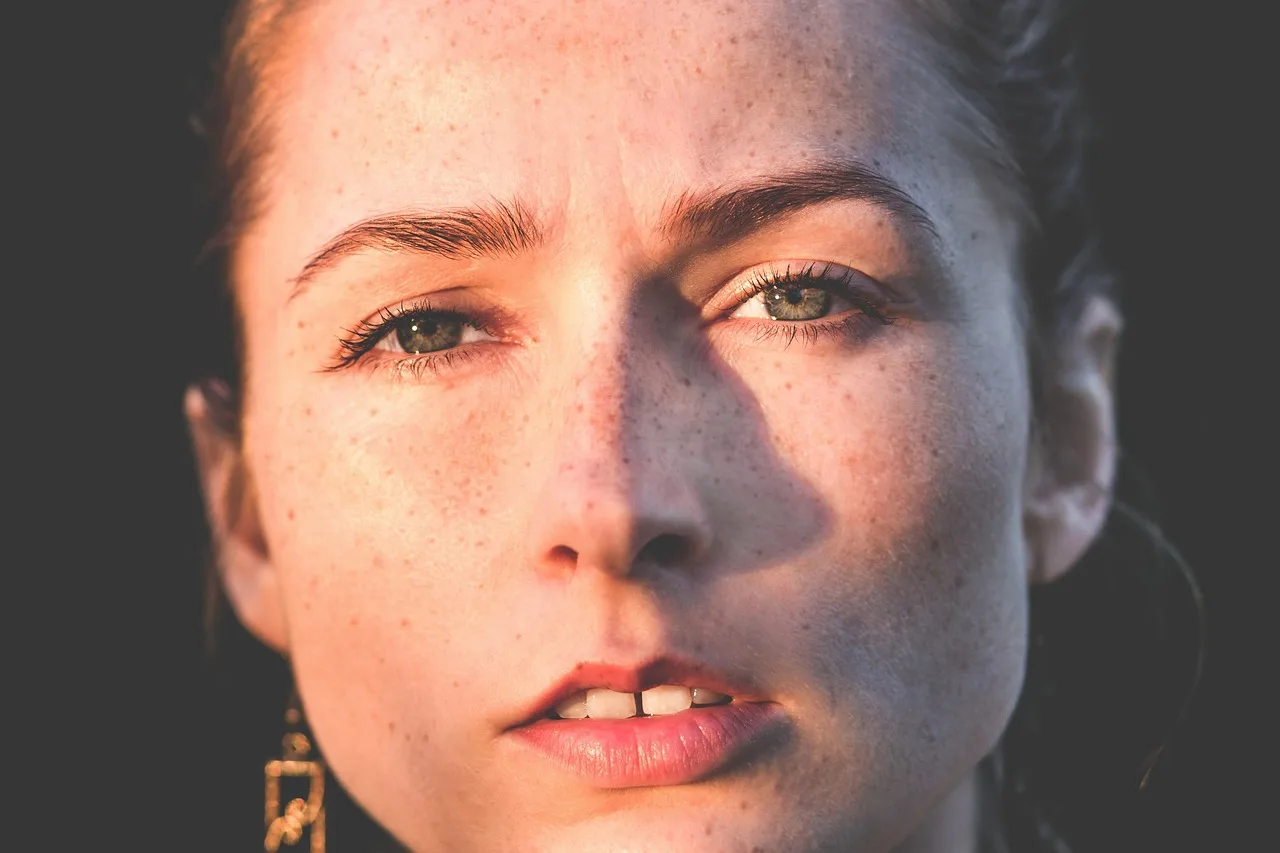
Zoom to the forehead, the nasolabial folds and the under-eye area. Pores, fine lines and texture are costly to remove and usually stay partly visible.
Edits often land at the jawline and the neck. Look for a jaw edge sharper than the ear, or a neck tone that does not match the chest.
The four decisions made before the shutter
- Lighta large window, an overcast day or a softbox, chosen to reduce texture.
- Lensa front camera at arm's length, or a longer lens from further back.
- Skin prepmoisturizer, primer and a sheer base that photograph as nothing.
- Postmild smoothing, warmth and contrast applied to the whole frame.
A photo claim versus what it can support
Photo claims vs. what images support
What the photo suggests
- Skin cleared
- Lighting or exposure changed
- No makeup
- No visible product in one image
- Filler dissolved
- Swelling settled or effect ran out
- Aged backwards
- Lens, distance, angle, retouching differ
What a single image can support
- Skin cleared
- No makeup
- Filler dissolved
- Aged backwards
Two photos side by side invite a story: she stopped wearing makeup, she had something done, she aged ten years. A single frame can carry a description of light, distance and texture. It cannot carry a cause. A change claim needs a matched pair, and a procedure claim needs a date and a record, neither of which the image itself provides.
Worked example: one face, three setups
Take one subject and three images from one month. The first is a front camera selfie beside a window. The second is a longer lens in a studio with a softbox. The third is a paparazzi frame in direct sun.
Read together, the three frames disagree about pores, jawline and under-eye hollows. Nothing about the face changed between them. What changed was the setup and the post-processing.
If you see only one of the three, your timeline inherits that setup's bias. Date stamps alone prove very little.
A checklist for reading any bare face photo
- Note the light direction and whether shadows are soft or hard.
- Note the camera distance and whether the nose looks stretched.
- Check texture on the forehead, cheeks and under-eye skin.
- Compare the jaw edge with the ear and the neck with the chest.
- Ask what the same person looked like under matched conditions.
Tools that help you check a photo
Retouching leaves traces, and free tools will show them. Error level analysis, the technique used by sites such as FotoForensics, highlights the parts of a frame that were saved at a different compression level than the rest, which is a common sign of a local edit. Reverse image search, which Google Images, TinEye and Bing Visual Search all offer, turns up earlier versions of the same frame, and often the original file. Photo metadata, the EXIF block a camera or phone writes into the file, records the device, the date and any editing software, unless the upload stripped it.
None of this proves what happened to a face. It only shows how much the photograph itself was worked on, which is what a timeline needs to know before it claims anything.
What this changes in a transformation timeline
A timeline can honestly claim sequence, not cause. Two photos taken months apart are two photographs unless the conditions match.
Medical recovery runs on swelling, not on photo dates. The Wikipedia article on rhinoplasty describes swelling that can persist for months, which is why the first flattering photo is often the least informative.
Injectable effects expire on their own schedule. Cosmetic botulinum toxin typically relaxes a treated area for about three to four months, so a photo taken near the end of that window shows a fading result, not a new baseline.
Product claims are overseen, and before and after images that drive sales are claims. In the United States, Section 5 of the Federal Trade Commission Act bars deceptive advertising, and the agency's Endorsements Guides, at 16 CFR Part 255, require advertisers to be able to substantiate what those images imply. Health Canada's cosmetics pages point to the Food and Drugs Act and the Cosmetic Regulations, the equivalent rules for cosmetics sold in Canada.
A before and after pair is evidence of two photographs. It becomes evidence of a change only when light, lens and retouching are held constant.
Common questions
Do no-makeup photos ever show a truly bare face?
Sometimes, especially in news frames shot in harsh light. The reader usually cannot verify it, so treat the claim as unproven.
How many photos do I need to judge a transformation?
Three or more, taken in different light and from different distances. One image shows a style, not a face.
Does retouching always mean deception?
No. Compression, exposure and the camera's own processing change an image before any person edits it. The point is to read the picture, not to accuse.
Can a timeline rest on one pair of dates?
Only as a sequence claim. To support a change claim, the pair needs matched conditions.