Costs
Celebrity smiles styles: camera, lighting, retouching
Celebrity smiles styles come from lens length, lighting and retouching as much as from dentistry, plus the questions to ask before any dental work.
What the pictures sell as celebrity smiles styles is a production effect. A smile in a publicity photograph is no record of anyone's teeth. It comes from a process: a flattering lens, lights that fill the shadow under the lip, and a shutter fired dozens of times for one usable frame.
A retouching pass afterward routinely includes the teeth. By the time you see it, the image has passed through more hands than the person's dentist.
That matters, because these pictures are the reference material people carry into a dental appointment. If you have ever saved a photograph and thought that one, it is worth knowing what you actually saved.
What to take away
- Focal length and shooting distance change the proportions of a face more than most people expect.
- Retouching teeth is ordinary commercial practice, not a scandal: whitening a little, evening an edge, lifting a shadow between two teeth.
- We do not publish guesses about whether a named person has had dental work.
- The two halves of this subject run on different clocksa retouch takes minutes, while work on teeth happens over appointments and, if enamel is removed, lasts for life.
- The useful version of this page is not a gallery.
What the camera did before anyone opened the file
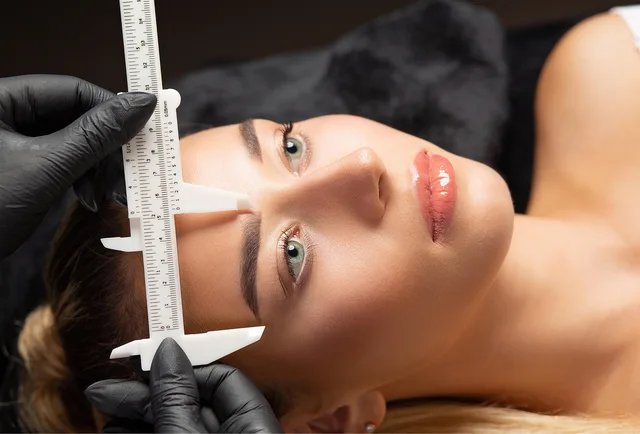
Focal length and shooting distance change the proportions of a face more than most people expect, an effect cataloged as perspective distortion. A short lens used close in enlarges whatever is nearest it and pushes everything else away. A longer lens used from further back compresses the same face into something flatter and wider.
Two distances do most of the work in published portraits: a wide lens of about 24mm held close, which enlarges whatever is nearest it, and a portrait lens of about 85mm used from across a room, which compresses the same features.
Short lens vs long lens
Short lens, close
- Smile width
- Enlarged
- Nose length
- Stretched
- Jaw set
- Pushed away
- Nearest feature
- Enlarged
Long lens, far back
- Smile width
- Compressed
- Nose length
- Flattened
- Jaw set
- Wider
- Nearest feature
- Even
Two photographs of one person, taken minutes apart with different lenses, will disagree about the width of the smile, the length of the nose and the set of the jaw. Neither is lying. They are answering different questions.
Lighting does the rest. A soft source placed high and centered just above the face — butterfly lighting, the classic beauty and portrait setup — fills the shadow under the lip; add a fill light from below and you have the clamshell setup used for red-carpet portraits. Teeth then read brighter and more even than they look across a table. A hard light from the side finds every ridge and shadow line.
Event photography is lit for one job: a bright, legible face at distance, shot in seconds. That job produces a particular kind of mouth.
The look people call the Hollywood smile — uniform, very white, evenly sized teeth — is as much a photography result as a dental one. Under butterfly light and a mild retouch, an ordinary healthy mouth reads close to it.
The styles you can actually tell apart
The published looks are not one look. The ones worth naming are named here, and attached to nobody.
- The Hollywood smile.Uniform, very white, evenly sized teeth — what a butterfly or clamshell setup and a mild retouch produce most easily.
- The natural smile.A gap between the front teeth, a slightly rotated incisor, a chipped edge left alone. Soft light lets those details read as character; a hard side light reads them as uneven.
- The gummy smile.Where the upper lip lifts high above the gum line. It is the least forgiving shape under a hard source and the easiest to soften with a raised chin and a large soft key light.
- The closed-lip smile.No teeth shown, which is a lighting result too: mouths that look tight under direct flash often open up under continuous light.
Four descriptions of what a photograph shows. None of them is a claim about anybody's dentistry.
What happened after
Retouching teeth is ordinary commercial practice, not a scandal: whitening a little, evening an edge, lifting a shadow between two teeth, usually with the healing brush or clone tool in Adobe Photoshop or a smoothing app such as FaceTune. It is also invisible by design, which is the point of doing it well, and it sits at the mild end of a long documented history of photograph manipulation.
Then there is the pass nobody performs deliberately. Phone cameras and social apps apply smoothing and brightening at capture, often by default. An image can be retouched before it has been taken.
The part we will not do
We do not publish guesses about whether a named person has had dental work, and their medical and dental history is theirs to discuss or not.
A photograph cannot support that claim either way, and every difference between two pictures has a dozen innocent explanations. The ones above are only the technical ones. Weight, age, a new haircut, a different lipstick and a decent night's sleep all change how a mouth reads.
What a claim like that does do is follow a real person permanently. So this page is about the photographs and about your own decisions, and it names nobody. The same team-based construction applies to celebrity makeup, where lighting and retouching build the published face.
If you are thinking about your own teeth
The useful version of this page is not a gallery. It is the set of questions worth asking before anyone touches your mouth.
Questions before dental work
- Check the public register by name
- Ask who performs the work
- Ask what is removed, and if it returns
- Ask what happens in ten years
- Ask what 'results vary' is covering
Check the register. Every country with a dental profession keeps a public list of who is licensed to practice, and it is searchable. In the United States that list is your state dental board's license lookup, run by the board of dentistry in the state where the treatment happens. Look up the individual who will be treating you, by name, not the clinic's brand, which is a marketing entity and can be registered to anybody.
Ask who actually performs the work. The person running the consultation is not always the person holding the instruments. Ask for that name, then check that name.
Ask what is removed, and whether it comes back. Bonding is added to the surface of a tooth and can be redone; a veneer or a crown means removing enamel that does not grow back. Some approaches change a tooth permanently and some do not. That distinction is the single most important thing to understand about your own case, and the person proposing the work is the one who has to explain it to you clearly, before you agree to anything.
Ask what happens in ten years. What is the maintenance? What typically needs redoing, on what sort of horizon? What does that cost? If something needs correcting soon after, who pays?
Ask what "results vary" is covering. That phrase is doing real work in the small print. Your starting point, your bite, your gums and your habits all sit between you and the picture on the clinic wall. A practitioner who tells you plainly what they cannot promise is worth more than one who promises.
Bring the photograph, but talk about your own face. A reference image is a good way to say what you like. It is a poor way to set a target, because the image is a lighting decision as much as a dental one, and because it is somebody else's face on somebody else's skull.
How the timelines run
The two halves of this subject move on different clocks, and that is the part nobody mentions until afterwards.
A retouch is finished in minutes, and the photograph it corrects was taken in a fraction of a second. Nothing in that half of the picture has to heal.
Work on teeth runs on appointments. Bonding, which is added to the surface of a tooth, is usually done in a single visit. A veneer or a crown is prepared on one visit and fitted on a later one, because a dental laboratory makes the piece in between. That gap is somebody else's schedule rather than your treatment, and it is where most of the waiting sits.
Then the horizon. Bonding can be redone. A veneer or a crown removes enamel that does not come back, so that version of the timeline does not end when the work ends — it runs for the rest of your life, with repairs along the way.
Where the money goes follows the same split: the appointment, the laboratory work, and the correction if something needs redoing soon after. Ask what a quoted fee covers, and what a redo costs, before anything is booked.
Where to check things for yourself
Your state dental board publishes the register, the standards practitioners are held to, and the complaints route if something goes wrong; complaints are filed with that board, not with the clinic. The American Dental Association runs a consumer site, MouthHealthy, but it does not license or discipline anyone. That board is the source worth opening. Not a clinic's own gallery, and not us.
The permanence question, which outranks everything on this page, is set out in veneers. What a written plan should contain before any money moves is in celebrity smiles, and how commentary about faces gets manufactured in the first place is in beauty expert analysis.
Common questions
Can you tell from a photograph whether someone has had work done?
No, and neither can anyone else. Lens, light, angle, makeup and post-production each change how teeth read, and any one of them can produce a difference that looks like a procedure.
Why not cover which public figures have had what?
Because it is a medical claim about a real person, made without evidence and without their consent. It does not stop being that because it is popular.
Is a clinic's before-and-after gallery useful?
It is a selected sample, published by the party selling the service. Ask how the photographs were taken, and whether the lighting, lens and distance were the same in both. More on that in before and after timelines reviews.