Features
How to choose skincare routines: audit your feed, then match a routine to your skin
How to choose skincare routines: audit what each account sells, see how celebrity transformation timelines mislead, then match product types to dry, oily, sensitive or ageing skin with realistic timeframes.
Most advice on how to choose skincare routines starts with products. This page starts one step earlier, with the thing that decided what you were shopping for: the set of images you look at every day, and above all the celebrity "skin transformation" posts in it.
That set is a choice, even though it does not feel like one. It is also the only part of this whole subject you can change today, for nothing, with an effect you will notice inside a week.
What to take away
- Your comparison set is an input to every decision you make here, and almost nobody chooses it deliberately.
- An account is not good or bad. It is selling something, showing something, or neither, and knowing which changes how you read it.
- A useful reference image is an unflattering one, because it was taken in conditions like yours.
Why the feed is the first decision
Nobody decides to compare themselves against a lit and graded photograph. It happens because that is what arrived. Over weeks, a feed sets a baseline for what ordinary skin looks like, and the baseline is made of production rather than of people.
The consequence is specific rather than vague. When you go to judge whether a routine is working, you are judging against that baseline, and the baseline is unreachable. So the routine fails a test it was never able to pass, and the next purchase gets made. Why the least produced looking images are the most produced is in no-makeup looks.
The audit, which takes twenty minutes
Scroll back through the last two weeks and write down, for each account you meet more than twice, three things: who it is, what it wants, and how it is shot.
| Column | What to write | Why it matters |
|---|---|---|
| Who it is | Name and role: celebrity, brand, clinic, creator, clinician or friend, plus any brand it fronts | The same face can be a person in one post and an advertisement in the next |
| What it wants | "Sells X", a booking, a follow, an affiliate click, or "nothing found" | Shows whether the picture was made to inform you or to move you |
| How it is shot | Studio light, ring light, filter or phone in a bathroom | Light and editing decide most of what skin looks like on a screen |
Feed audit: three columns
- Whoperson, brand, clinic, publication, agency
- What it wantspurchase, booking, attention, nothing
- How it is shotphone, studio, professionally graded
- Write for each account met more than twice
- Read the list, not the feed
The three columns, filled in:
- Who it is.A celebrity, a brand, a clinic, a creator, a clinician or a friend. Write the name and, where the account has one, the brand it fronts. This matters because the same face can be a person in one post and an advertisement in the next.
- What it wants.A sale, a booking, a follow, an affiliate click, or nothing. Write "sells X" or "nothing found". This matters because it tells you whether the picture was made to inform you or to move you.
- How it is shot.Studio light, ring light, a filter, a phone in a bathroom. Write what you can see. This matters because light and editing decide most of what skin looks like on a screen.
Then read the list rather than the feed. Most people find that four or five accounts account for nearly all of the pressure, and that most of those were shot in a studio.
A worked example: the celebrity transformation post
The post that does the most damage to a routine is the celebrity skin transformation: two frames, months apart, and a caption crediting a product line or a clinic. Run the three columns over it.
Who it is: a famous face, and often a brand partner. What it wants: usually a sale of the product named, or a booking at the clinic tagged. How it is shot: the second frame is typically lit and graded, the first often is not.
Then look at the timeline the post implies. It compresses months of an unknown routine, and possibly treatments that are not mentioned, into a single swipe, and asks you to expect the same change from one bottle. No routine you buy can be measured against that, because you do not know what produced it. Write the post down, note the brand, and move it out of the set you compare yourself with.
What to keep and what to move
Keeping something is fine. The move that helps is separating the categories so they stop blending into a single impression of how faces look.
- Keep the craft accounts.Photography, lighting, makeup artistry as a trade. These teach you what you are looking at and they are the most interesting of the lot.
- Keep the clinicians who teach rather than diagnose.General information published by a qualified person is useful. An opinion about a stranger's face is not, and the difference is examined in beauty expert analysis. Score a clinician's post with the ten-point score.
- Move the aspirational feeds into a separate list, if the platform allows it, so that looking at them is a decision rather than an ambush.
- Unfollow the comparison accounts entirely.Anything whose format is a paired image of somebody who did not consent is doing you no good at all; documented procedures explains why this site publishes none.
- Add two or three domestic-light accounts.Ordinary rooms, ordinary cameras, no grading. They are less flattering and therefore more informative.
Building a reference set that is worth something
A reference image is useful for naming a color, a finish or a level of coverage. It is useless as a target, because the target includes lighting you cannot buy.
Rules for useful references
- Find product on an ordinary face, ordinary room
- Find swatches shot in daylight, not shop fittings
- Choose video over a still
- If two images disagree, keep both
- Read the words attached slowly
Collect references with that job in mind. Find the product on an ordinary face in an ordinary room, and find swatches shot in daylight, not under a shop's own fittings.
Choose video over a still, since video is harder to select from. If two images of the same product disagree completely, keep both, because the disagreement is the finding.
The words attached to those images are worth reading slowly too. A great many of them are narrower than they sound, and the list of what each one commits anybody to is in no makeup looks: how to read the photo.
Where the advertising rules sit
Much of what you have just audited is formally advertising, whether it announced itself or not.
Where money, a product, or an affiliate arrangement is behind a post, that is supposed to be visible. The FTC's disclosure rules for people posting on social media, summarized in its guide Disclosures 101 for Social Media Influencers, set out where the disclosure belongs and what does not count as one.
Claims about what a product does to skin sit under a second regime again. The Food and Drug Administration's account of how cosmetics are regulated without being approved is short, and it explains why a confident sentence on a packet is not a tested one.
Matching product types to your skin
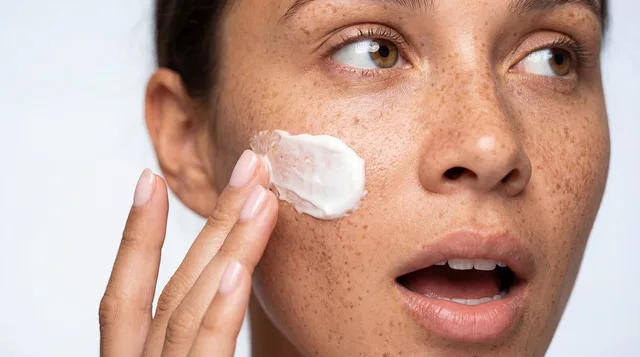
These are general starting points, not a diagnosis. Whatever the concern, the base is the same: a gentle cleanser, a moisturizer and a broad spectrum sunscreen.
- Dry skin:a fragrance-free moisturizer with ingredients such as glycerin, ceramides or hyaluronic acid, applied after washing.
- Oily or acne-prone skin:a gentle cleanser and a non-comedogenic moisturizer. Over-the-counter acne ingredients include benzoyl peroxide, salicylic acid and adapalene. Start with one, because they can dry and irritate.
- Sensitive skin:fragrance-free products, one new product at a time, and a patch test first.
- Dark spots and fine lines:daily sunscreen first. A retinoid, such as over-the-counter adapalene or a prescription product, is the next step, introduced slowly because irritation is common in the early weeks.
Realistic timeframes help you judge a celebrity transformation post. Acne products usually need several weeks, and retinoids and brightening products often need several months, in line with the academy's six-week to three-month range below. A post showing clear skin after "two weeks of this serum" is outside those ranges, so it is selling something other than the serum, such as lighting, editing or an unmentioned treatment.
Then, and only then, the routine
With the input sorted, choosing a routine becomes ordinary. Take one change at a time, use the trial period a pharmacist suggests rather than the one on the box, treat comfort as the main signal, and pick a cost you can sustain indefinitely.
The American Academy of Dermatology's advice on getting results from skin care products turns that into steps you can follow. Start with one product, because using several at the same time can irritate your skin. Test it first on a small area of your inner forearm, twice a day for four to five days, and move it to your face only if the skin there looks normal. Stop a product that stings, burns or tingles, unless a dermatologist prescribed it and says that is expected. Then give it time: the academy says a moisturizer can plump up fine lines in a few days, but most products take at least six weeks to work, and sometimes up to three months. That is the honest timeline to hold against a celebrity post that shows a change in one swipe.
One step has a public standard behind it, and it is the one celebrity posts mention least. The FDA's advice on sunscreen and protecting your skin is to use broad spectrum sunscreens with sun protection factor (SPF) values of 15 or higher regularly and as directed, and to reapply at least every two hours, more often when sweating or swimming. Whatever else the routine contains, that step is the one to keep.
For everything else, read the label as the claim it is. A product that says it changes how the skin works is making a drug-type claim; one that says it moisturizes or improves appearance is making a cosmetic one, and the FDA page on cosmetics law above explains why the second kind is not approved by the FDA before sale.
Choosing the routine
- Take one change at a time
- Ask a pharmacist for a fair trial period
- Treat comfort as the main signal
- Keep a cost you can sustain indefinitely
- Stop and see a doctor if sore or spreading
For ideas sorted by effort and payoff, see skincare routines ideas.
Anything sore, spreading or not settling stops being a shopping question at that point and belongs with a pharmacist or a doctor who can look at you. To check a surgeon's licence before any procedure, see how California's medical board vets surgeons.
Common questions
Does curating a feed actually change anything?
It changes what you are comparing yourself against, which is the input to every other decision here. People notice the effect within a week or two, and it costs nothing.
Is it not a bit precious to audit what I look at?
It felt that way to write down too. It is also the only intervention on this site that is free, reversible and immediate, which makes it a reasonable thing to try first.
What if the account I find most useful is also selling something?
That is extremely common and it is not disqualifying. Note the arrangement, weight the opinion accordingly, and take the shopping decision on a different day. Where sources go wrong more generally is covered in the photo-pair checklist.
Can I keep the aspirational accounts if I enjoy them?
Yes. Enjoyment is a perfectly good reason to look at photographs. The distinction worth keeping is whether you are looking at a picture or measuring yourself against it.