Guides
Before and after timelines examples: five photo effects, no surgery
Five before and after timelines examples: the lens, the light, eight ordinary years, the editing pipeline and the choice of frames. No procedure needed.
The before-and-after pair is a persuasive format because it looks like a controlled experiment. Two images, one variable, an obvious conclusion. Almost none of them are controlled experiments.
Below are five before and after timelines examples: ordinary situations in which two photographs of the same face disagree completely, and nothing happened in between. They are illustrative, not case studies of any person. The point is how easy the effect is to produce, and therefore how weak a photo pair is as evidence of anything.
What to take away
- Five ordinary situations, all of them common, produce a visible difference between two photographs of one face with nothing done to the face at all.
- Several of them are usually operating in any published pair at once, which is why the pair cannot establish that anything happened.
- The same five effects are working on the pictures you take of yourself, which is the part worth doing something about.
One: two lenses, one afternoon
Somebody is photographed at arm's length on a phone, then again from across the room on a long lens.
Lens and distance change the face
Close, wide lens
- Nose
- Narrower
- Face
- Wider
- Jawline
- Different
- Eyes to temples
- Changed
- Geometry
- Enlarged near
Far, long lens
- Nose
- Wider
- Face
- Narrower
- Jawline
- Different
- Eyes to temples
- Changed
- Geometry
- Compressed flat
What a viewer sees. A narrower nose, a wider face, a different jawline, a changed relationship between the eyes and the temples.
What happened. Focal length and camera distance change apparent facial proportion. Close and wide enlarges whatever is nearest the lens; far and long compresses everything toward the same plane. Both images are accurate recordings. They are recordings of different geometry.
Two: the light moved
The same person, the same hour, the same room. First frame lit softly from the front, second lit hard from above and to one side.
What a viewer sees. Cheekbones that appeared and a jaw that sharpened. Under-eye shadow that arrived from nowhere. Skin that changed texture.
What happened. Shadow position is chosen by the person holding the light. Contouring exists as a technique specifically because painted shadow and real shadow are read the same way. Move the lamp and the bone structure appears to move with it.
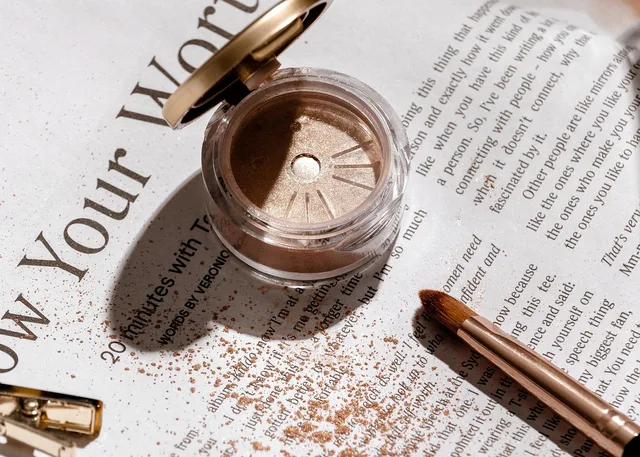
That is the entire second scenario in one object. Placed high and close it fills the hollows and a face reads smooth and even. Moved back and to the side it does the opposite, on the same face, in the same minute.
Three: eight years, no intervention
Two portraits taken eight years apart. Nothing was done in between.
What a viewer sees. A changed face and a strong urge to explain it.
What happened. Faces change over years without anybody's involvement. Weight moves and settles differently. Skin changes. Teeth get treated because teeth need treating. Hairlines move. Glasses arrive. Someone stops or starts smoking, sleeping, drinking, running. A decade is a lot of ordinary life, and it is all visible.
Four: the same face, published twice
One image goes out through a publication's own pipeline; another circulates as an unedited frame.
What a viewer sees. A gap that looks like an event.
What happened. The published version was graded for color and contrast, and retouched: skin evened, stray hair removed, an outline tidied. This is routine production work, applied to nearly everything commercial, and it is invisible when done competently: the mild end of a long history of photograph manipulation. Increasingly the unedited frame is not unedited either, because phones and apps smooth and brighten at capture by default. There may be no true "before" in the pair at all.
Five: the pair was chosen
Someone selects two images from a large archive with a conclusion already in mind.
What a viewer sees. A striking contrast.
What happened. Selection. Out of thousands of frames of any frequently photographed person, some pairs will differ dramatically for the technical reasons above. Choosing those two is not evidence; it is illustration of a claim that was made first. The same archive will produce a convincing pair for the opposite conclusion.
What the five cases have in common
Every one produces a visible difference with no procedure involved. Since any of them can be operating in any given pair, usually several at once, a photo pair cannot establish that a procedure occurred — not in a clinic's own before-and-after gallery, not for a public figure, not for anyone.
This site does not run comparison pieces about named people, and that is not a matter of taste. The format cannot support the claim it makes, and that claim attaches to a real person's body permanently, without consent.
The reasoning is set out in why documented procedures cannot be judged from photographs, and the commentary industry built on the format is examined in beauty expert analysis of two photographs.
Using this on yourself
The same five effects are working on the images you compare yourself against, and on the images you take of yourself.
Remove variables for real change
- Same spot, same time, same light source
- Same distance and same camera
- Camera at eye level, face straight on
- Filters and beauty modes off
- No makeup in either, or same makeup
- Keep every frame, review whole series
If you want to track a genuine change (a routine, a treatment, healing), the fix is to remove the variables rather than fight them:
- Same spot, same time of day, same light source. Daylight from a window, not a bathroom fitting.
- Same distance and same camera. Mark where you stand.
- Camera at eye level, face straight on, same expression. Small angle changes do a lot.
- Filters and beauty modes off. Check the settings; some are on by default and stay on.
- No makeup in either, or the same makeup in both.
- Keep every frame, including the unflattering ones, and look at the whole series rather than the best and worst.
Do that and your own photographs become mildly informative. Skip it and you have produced exactly the format described above, with yourself as the subject.
Further on how these images are used commercially: how before and after timelines are used in advertising. What to ask a clinic about its own gallery is in before and after timelines reviews of clinic photography.
Common questions
Which of the five explains the most published pairs?
The fifth, because it sits on top of the other four. Once somebody is choosing two frames out of thousands with a conclusion already in mind, the technical effects only have to supply the raw material.
If I control for lighting, is my own pair reliable?
Better, and still not reliable as a pair. Lighting is one variable among lens, distance, angle, expression, makeup, time of day and processing. Holding one steady while the rest move is not a controlled comparison, which is why the advice is to keep the whole series.
A clinic told me its photographs are standardized. Is that enough?
It is a good sign and it is checkable. Ask what standardized means in practice: the same camera, the same marked distance, the same lighting setup, the same interval after treatment, and no retouching. A clinic that has thought about it will answer in a sentence.
Does any of this mean nothing ever changes?
No. Faces change constantly, for a long list of ordinary reasons. The claim being refused here is narrower: that a pair of photographs can tell you which reason.